Seamless installation
Form continuous gutter runs on site and coordinate hangers, outlets, corners, end caps, downspouts, and discharge.
Gutter services in Athens, GA
Seamless gutter installation, repair, and cleaning designed around roof runoff—not just the roof edge—to protect fascia, siding, landscaping, and foundations.
Request a gutter estimateSystemsSeamless aluminum
ServicesInstall, repair & clean
GoalControlled roof drainage
 Focused expertise · Athens, Georgia
Understand the system
A good gutter layout considers the roof area feeding each section, steepness, long runs, valleys, inside corners, outlet placement, downspout capacity, and where water will discharge at grade.
Overflow is not always a cleaning problem. The cause may be blockage, poor pitch, too few outlets, undersized components, valley concentration, loose hangers, or a discharge point that sends water back toward the building.
What we evaluate and address
Each request begins with the property type, system, symptoms, urgency, and location. That context determines what expertise and next step are appropriate.
Form continuous gutter runs on site and coordinate hangers, outlets, corners, end caps, downspouts, and discharge.
Remove failing or undersized sections and correct layout issues instead of copying a weak existing configuration.
Address leaking corners, separated joints, loose hangers, poor pitch, damaged outlets, and disconnected downspouts.
Remove roof debris and outlet blockages, then observe obvious pitch, attachment, and drainage concerns.
Improve outlet placement, elbows, extensions, and discharge paths that carry water away from the structure.
Identify where concentrated roof water overwhelms the system or reaches fascia, siding, walks, landscaping, or foundations.
Follow the water
Every component has to pass the runoff to the next one without creating overflow, erosion, or discharge beside the building.
Collects rainfall across multiple planes and valleys.
Receives concentrated edge flow at the proper pitch.
Transfers water without becoming the bottleneck.
Carries volume vertically to a controlled discharge.
Moves runoff away from walls, walks, and foundations.
Choose the property type
Homes and commercial buildings move roof water differently. The right solution starts with the roof area, collection points, discharge path, and maintenance access.

Residential layouts balance appearance with capacity across valleys, corners, porches, landscaping, walks, and practical discharge locations.
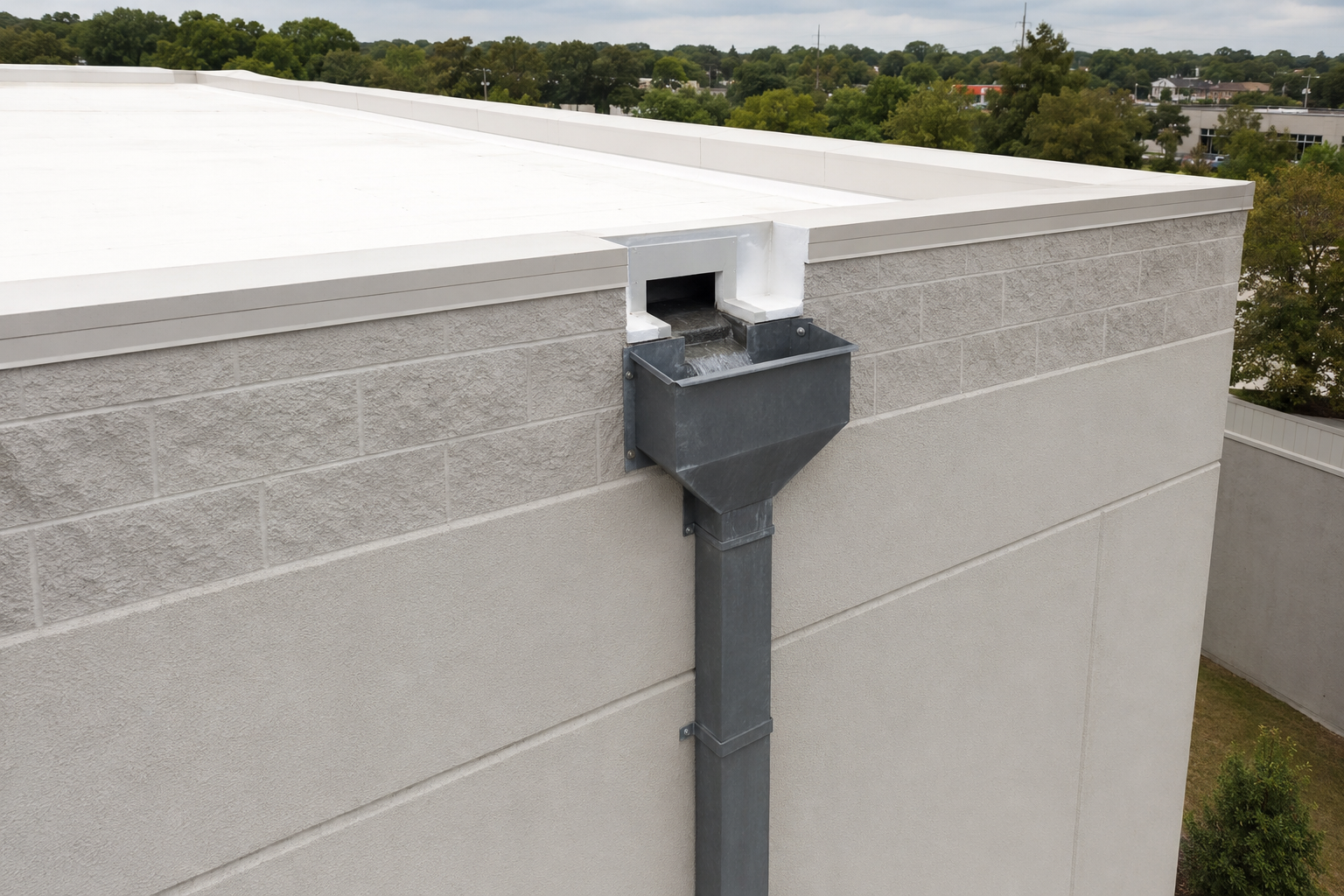
Commercial drainage may combine internal drains, scuppers, collector heads, gutters, and downspouts around larger roof areas and occupied facilities.
Conditions worth investigating
One symptom rarely tells the whole story. These conditions help frame the inspection—not predetermine the answer.
Overflow may come from blockage, inadequate pitch, excessive roof flow, or insufficient outlet and downspout capacity.
Loose attachment, damaged drip-edge relationships, or roof-edge details can let water reach fascia and soffits.
Hanger spacing, damage, debris weight, or poor pitch can prevent the run from draining correctly.
Short, disconnected, or poorly located downspouts can concentrate roof runoff beside the building.
How the work should progress
The process should turn uncertainty into documented priorities and a practical path forward.
Review roof planes, valleys, long runs, corners, elevations, and likely high-volume collection points.
Place downspouts around capacity, appearance, walkways, landscaping, and practical paths away from the structure.
Create seamless runs, establish pitch, secure hangers, seal corners, and connect downspouts and extensions.
Review the completed path from roof edge through outlets and downspouts to the intended discharge area.
Decisions that shape performance
Larger gutters and outlets can manage more flow, but sizing should reflect roof area, geometry, concentrated valleys, and the number of downspouts.
More capacity at the gutter is not enough if outlets are poorly located or water cannot discharge safely at grade.
Guards can reduce some debris entry, but they do not eliminate maintenance and must suit the roof, debris type, pitch, and rainfall intensity.
Helpful answers
Good roofing decisions start with better questions. A property inspection is still necessary for a project-specific recommendation.
Seamless gutters reduce joints along straight runs, but corners, end caps, outlets, and transitions still require sealed details and periodic maintenance.
The right interval depends on nearby trees, roof shape, guard type, and how quickly outlets collect debris. Properties under heavy tree cover may need checks more than once a year.
The system may be partly blocked, poorly pitched, undersized, short on outlets, or receiving concentrated valley flow beyond the capacity of that section.
Not by themselves. Gutters must collect the water, downspouts must carry it, and extensions or underground drainage must discharge it to an appropriate location away from the structure.
Athens, Georgia
Tell us what you’re seeing. We’ll categorize the request and connect it with the appropriate roofing specialty.
Request a gutter estimate