Leak investigation
Trace likely water entry around seams, penetrations, curbs, drains, flashing, walls, and previous repair areas.
Commercial roofing in Athens, GA
Commercial roof investigation, repair, maintenance, and replacement planning for owners, property managers, facilities teams, and Athens-area businesses.
Request a commercial roof assessmentSystemsTPO, metal & low-slope
PrioritiesLeaks, uptime & budget
PlanningRepair through replacement
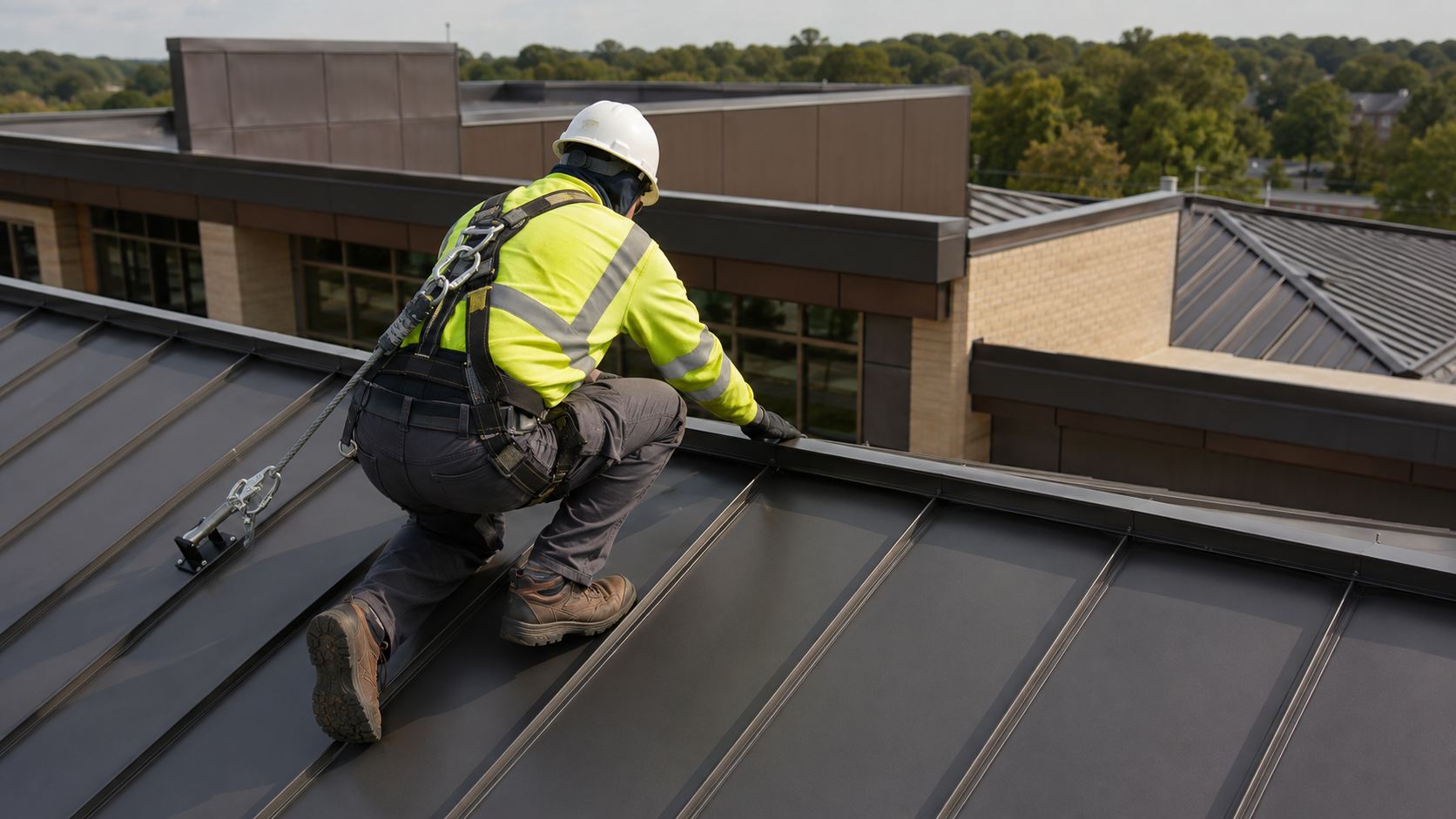 Focused expertise · Athens, Georgia
Understand the system
On a low-slope roof, the visible ceiling leak may be separated from the entry point by insulation, deck flutes, slopes, and roof layers. Mechanical curbs, drains, seams, penetrations, wall transitions, and prior repairs all become part of the investigation.
A useful commercial assessment does more than name a membrane. It organizes immediate leak control, near-term repairs, maintenance, restoration potential, and eventual replacement into a plan the ownership or facilities team can act on.
What we evaluate and address
Each request begins with the property type, system, symptoms, urgency, and location. That context determines what expertise and next step are appropriate.
Trace likely water entry around seams, penetrations, curbs, drains, flashing, walls, and previous repair areas.
Evaluate membrane punctures, open seams, flashing transitions, edge details, and heat-welded components.
Review debris, drainage, sealants, terminations, penetrations, and traffic damage on a planned schedule.
Determine whether the existing substrate and roof condition may support a restoration coating—and where coating is not appropriate.
Inspect panels, fasteners, seams, closures, transitions, penetrations, oxidation, and movement-related details.
Develop an organized scope around tear-off or recover options, insulation, drainage, phasing, access, and occupied operations.
Built for ownership decisions
A commercial roof report should help a property team decide what happens now, what belongs in maintenance, and what needs to enter the capital budget.
Locate active entry points, protect occupied areas, address open details, and document emergency repairs.
Prioritize seams, penetrations, drainage, traffic damage, sealants, flashing, and preventive work.
Compare repair, restoration, phased replacement, and full replacement based on actual roof condition.
Complete commercial protection
Commercial metal, low-slope membranes, roof drains, scuppers, gutters, and downspouts require building-specific access and maintenance planning.
Panel systems, movement details, penetrations, repairs, replacement, and occupied operations.
Explore commercial metal roofing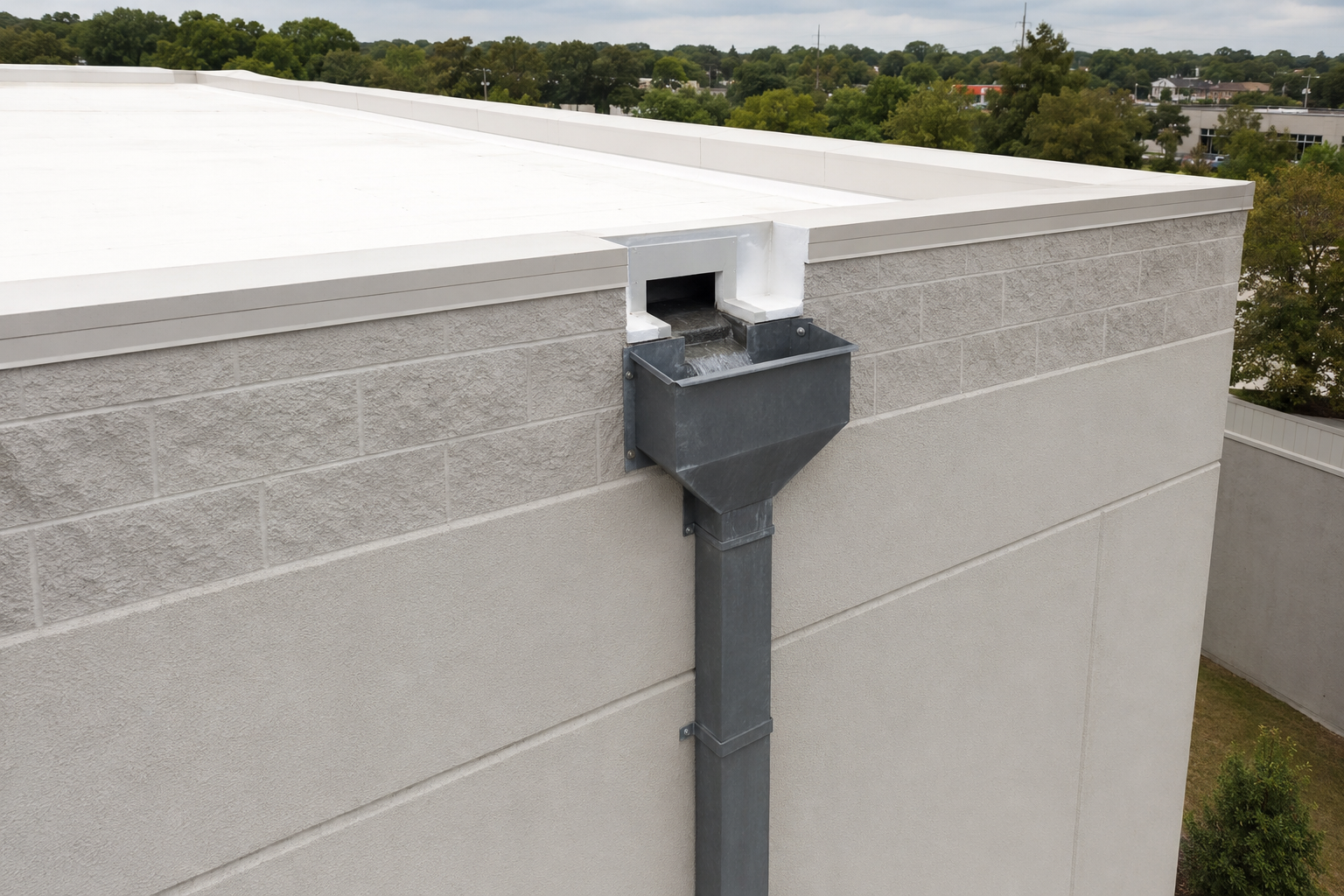
Drains, scuppers, gutters, downspouts, overflow routes, and maintenance priorities.
Explore commercial drainageConditions worth investigating
One symptom rarely tells the whole story. These conditions help frame the inspection—not predetermine the answer.
Repeated symptoms can indicate that surface patches are not addressing water migration or the underlying detail.
Standing water deserves review of drains, scuppers, debris, slope, insulation, and structural deflection.
Membrane and edge failures can expand quickly under wind and temperature cycling.
Moisture trapped beneath the surface can reduce thermal performance and complicate repair or restoration decisions.
How the work should progress
The process should turn uncertainty into documented priorities and a practical path forward.
Identify occupied areas, leak history, roof access, equipment, safety constraints, and business-critical zones.
Document membrane or panel condition, details, drainage, penetrations, repairs, and visible moisture indicators.
Separate emergency action from routine maintenance, corrective repair, restoration, and capital replacement.
Plan access, staging, weather protection, communication, and work sequencing around building operations.
Decisions that shape performance
Light-colored welded membranes are common on low-slope buildings; performance depends heavily on seams, penetrations, edges, drainage, and installation.
A coating may extend service life on a suitable, dry, well-prepared roof, but it should not be used to conceal saturated insulation or systemic failure.
Larger facilities may benefit from planned sections, but transitions and sequencing must preserve drainage and warranty continuity.
Helpful answers
Good roofing decisions start with better questions. A property inspection is still necessary for a project-specific recommendation.
Many repairs can be coordinated around occupied operations. Access, odors, noise, interior protection, weather, and the location of the work should be planned before mobilization.
Not automatically, but persistent water can accelerate deterioration and expose weak details. The cause and duration should be evaluated rather than ignored.
Coatings are best considered when the existing roof is a compatible, stable, and sufficiently dry substrate. Moisture, adhesion, drainage, and detail conditions should be assessed first.
A useful report identifies observed conditions, probable leak sources, photographs, immediate priorities, repair recommendations, maintenance items, and replacement considerations when relevant.
Athens, Georgia
Tell us what you’re seeing. We’ll categorize the request and connect it with the appropriate roofing specialty.
Request a commercial roof assessment